NASA and ESA Astronauts Complete Historic
NASA's Jessica Meir and ESA's Sophie Adenot conducted a six-hour spacewalk on September 1, 2026, performing maintenance and scientific tasks outside the
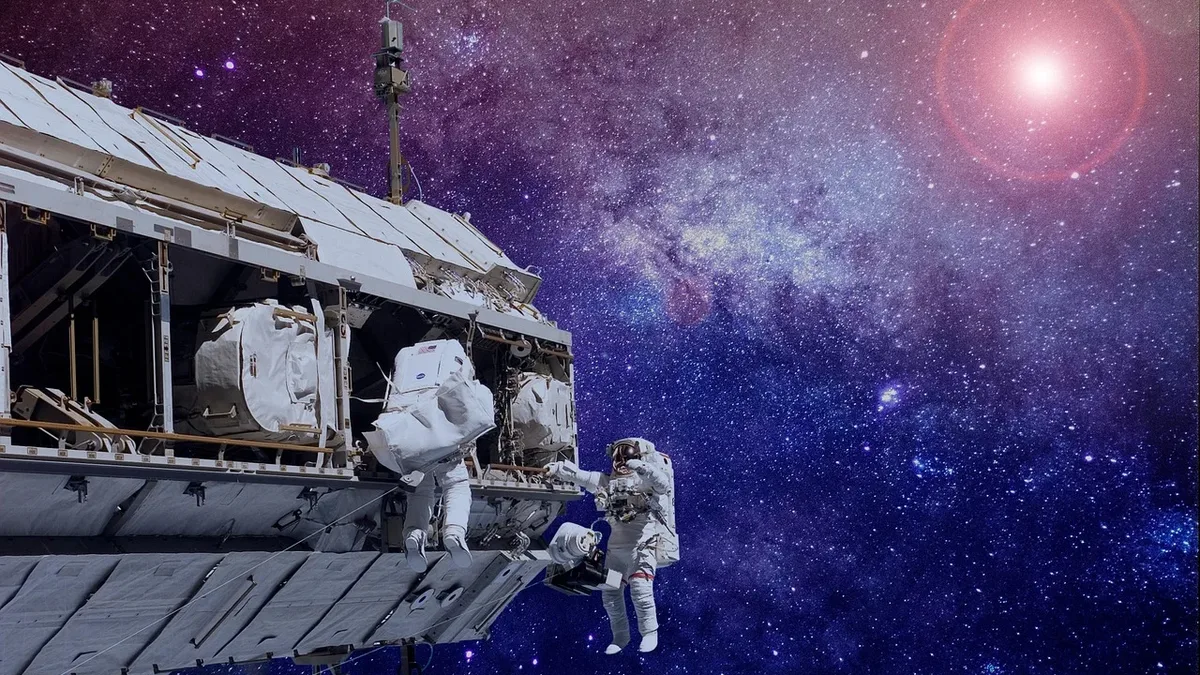
NASA astronaut Jessica Meir and European Space Agency astronaut Sophie Adenot completed a historic spacewalk on September 1, 2026. Their mission outside the International Space Station lasted six hours and forty-nine minutes.
During the extravehicular activity, or EVA, they replaced a spacecraft docking aid and an HD camera. They also performed other maintenance and scientific tasks. This was the sixth all-female spacewalk in history.
Jessica Meir's Path from Biology to Space
Jessica Meir began her career as a scientist. According to NASA's official biography, she holds a bachelor's degree in Biology from Brown University. She also earned a master's in Space Studies and a doctorate in Marine Biology.
Her research focused on animal survival in extreme environments. She studied emperor penguins in Antarctica and bar-headed geese that fly at high altitudes. This work later connected to human physiology research for spaceflight. NASA selected her as an astronaut in 2013.
Meir first traveled to the ISS in 2019. She was part of the first all-female spacewalk that same year. The September 2026 mission was her seventh spacewalk. NASA states she has now accumulated 49 hours and 22 minutes of spacewalking time.
Sophie Adenot's Journey from Test Pilot to Astronaut
Sophie Adenot's path was different. The European Space Agency says she studied aerospace engineering in Toulouse. She specialized in spacecraft and aircraft flight dynamics. Later, she earned a master's degree from MIT, researching how the human vestibular system adapts to artificial gravity.
Adenot joined the French Air Force and trained as a helicopter pilot. Her duties included search-and-rescue operations. She graduated as a helicopter test pilot from a school in the United Kingdom in 2018. Before becoming an astronaut, she logged about 3,000 flight hours across 22 helicopter types.
ESA selected her as an astronaut in 2022. She completed basic training in 2024. Her first space mission, called Epsilon, began in February 2026. The September spacewalk was her third EVA.
Teamwork During the Mission
The astronauts worked on specific hardware during their spacewalk. They replaced the docking-navigation reflector on the ISS's Harmony module. They also replaced Camera Port 3, an HD camera on the station's truss.
A minor issue arose late in the EVA. Adenot experienced reduced mobility in her left shoulder. Mission Control instructed her to stay in place until Meir could assist her. Once back at the airlock, Meir inspected Adenot's suit. She freed what appeared to be a cable caught near the shoulder joint.
Space.com reported that after freeing the old camera, Meir announced, "And it's off!" Her comment was followed by applause from Mission Control.
The mission highlighted diverse routes to space. Meir's journey shows a path from biological science. Adenot's story illustrates a path from engineering and military aviation. Their combined experiences underscore that modern astronaut selection values many skills. Scientific expertise, engineering knowledge, and aviation experience are all valid pathways. Resilience, adaptability, and teamwork remain critical. These qualities can lead to the same destination: the frontier beyond Earth.